
For most of the past decade, real estate technology focused on access.
More listings.
More maps.
More market data.
That mission largely succeeded. Buyers, sellers, and agents now operate in an environment where information is abundant and instantly available. But as access improved, a new problem emerged—one the industry is only beginning to confront.
The challenge is no longer finding data.
It’s understanding which data actually matters.
Why Market Knowledge Is Being Redefined
Experienced agents have always known that real estate markets don’t behave uniformly.
A ZIP code can contain multiple, distinct markets.
A city can hide dozens of competing micro-economies.
And in many condo and planned-community markets, the building itself functions as the market.
Yet most consumer-facing tools still treat real estate as a proximity exercise—flattening nuance into averages that obscure real behavior.
This disconnect is becoming increasingly visible to consumers.
According to research published by the National Association of Realtors and reinforced by reporting from Redfin and Zillow, buyers are spending more time researching before contacting agents—and asking more detailed, specific questions when they do.
Questions like:
Why does this building command a premium?
How does this subdivision perform compared to similar ones nearby?
What are buyers actually cross-shopping right now?
These aren’t questions answered by citywide stats.
The Shift From Visibility to Credibility
At the same time, a new class of agent has emerged.
Social platforms like TikTok, YouTube, and Instagram have lowered the barrier to visibility. Many agents now publish regular content, explain market trends, and educate audiences at scale.
But as real estate content has matured, so have audience expectations.
ZIP-code updates, generic price charts, and broad “market is up/down” commentary are increasingly interchangeable. Viewers can find those numbers anywhere.
What they can’t easily find is context.
The agents gaining long-term traction are those who can explain why markets behave the way they do—especially at the subdivision and building level.
In other words, the edge is shifting from marketing reach to market literacy.
Why Micro-Markets Matter More Than Ever
Appraisers and institutional investors have long relied on micro-market analysis. Identifying the true competitive set—rather than relying on proximity alone—is foundational to valuation standards and risk assessment.
That logic is now filtering into consumer expectations.
In condo-heavy and urban markets, value is shaped less by distance and more by:
shared governance and amenities
repeat floor plans and unit stacks
buyer perception of specific communities
internal supply and turnover
Two properties a few blocks apart can exist in entirely different economic realities.
When agents can articulate those distinctions clearly, they don’t just inform—they build trust.
Enter the Data-Driven Agent
This is where a new operating model is taking shape.
Data-driven agents aren’t trying to replace intuition or experience. They’re augmenting it with structured intelligence that reflects how markets actually function.
Instead of asking, “What’s the average price nearby?”
They ask, “What’s happening inside this specific community?”
Instead of broad comparables, they focus on apples-to-apples substitutes.
This approach doesn’t simplify the market.
It explains it.
How Hyperlocal Advisor Fits Into This Evolution
Opening in Q1 2026, Hyperlocal Advisor is positioning itself as an AI-native real estate brokerage built explicitly for this next phase of agent intelligence.
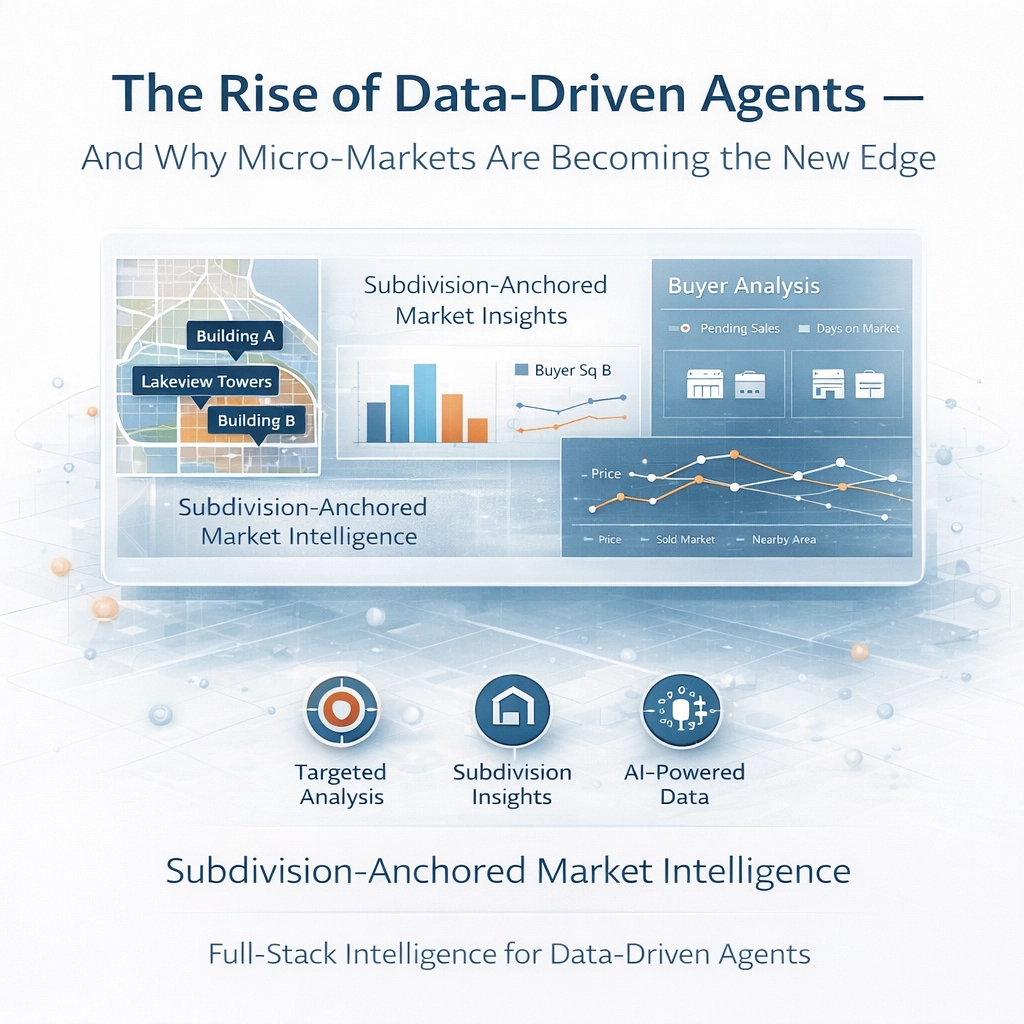
Rather than centering on listings alone, the platform is powered by subdivision- and building-level market data from Subdivisions.com—a proprietary dataset designed to model real estate at the micro-market level.
The goal is straightforward:
give agents access to clearer market context
organize data around how buyers actually compare homes
use AI to assist with interpretation, not prediction
This isn’t about automation replacing professionals.
It’s about reducing noise so expertise can surface faster.
Why This Matters for Modern Agents
For agents already investing in education-based content and market analysis, this shift is especially relevant.
Subdivision-anchored intelligence enables:
more precise market explanations
better consumer education
stronger positioning as a local expert
fewer conversations built on averages and assumptions
As audiences become more informed, credibility compounds.
An Invitation, Not a Recruitment Push
Hyperlocal Advisor is not approaching the market with a volume-driven recruitment model.
Instead, it’s extending an invitation to agents who already believe that:
insight outperforms exposure over time
structured data strengthens judgment
market literacy is becoming non-negotiable
The brokerage is being built around that premise.
The Bigger Picture
Technology didn’t change how real estate value is formed.
It changed how quickly people expect it to be explained.
As buyers and sellers demand more transparency, agents who understand markets at the micro level will continue to stand apart—regardless of platform trends.
The rise of data-driven agents isn’t about replacing the human role in real estate.
It’s about elevating it.
About Hyperlocal Advisor
Hyperlocal Advisor is an AI-native real estate brokerage opening in Q1 2026. Powered by subdivision- and building-level intelligence from Subdivisions.com, the platform is designed to help agents, buyers, and homeowners understand real estate value through structured micro-market data, analytics, and AI-assisted interpretation.