

Over the past five years, platforms like TikTok and YouTube have reshaped how real estate agents build visibility.
According to the National Association of Realtors, video and social media are now among the most commonly used tools for agent marketing, particularly among newer and mid-career professionals. Short-form video, neighborhood walkthroughs, and market explainers have lowered the cost of audience-building and accelerated trust at scale.
But as adoption increases, differentiation becomes harder.
The agents who gain attention next won’t simply be those who post more frequently or edit better videos. They’ll be the ones who can explain markets with clarity, precision, and relevance — especially at the local level.
The Maturity Problem in Real Estate Content
Real estate content is no longer novel.
ZIP-code market updates, median price charts, and broad “Is now a good time to buy?” videos still perform — but they increasingly sound the same. Large portals and brokerages publish similar data weekly. Consumers can find those numbers on their own.
This creates a credibility gap.
As platforms mature, audiences begin to expect more than surface-level information. Research from platforms like YouTube and Google consistently shows that educational content performs best when it answers specific questions, not generalized ones.
In real estate, those questions are rarely citywide.
Real Estate Markets Are Not Uniform — and Never Were
Professional agents and appraisers have always understood something most platforms still flatten:
Real estate markets operate at the micro level.
Academic research, appraisal standards (USPAP), and brokerage best practices all emphasize the importance of identifying the true competitive set. That set is rarely defined by proximity alone.
In many markets — particularly condos and planned communities — pricing and demand are shaped by:
the building or subdivision
shared amenities and governance
unit layouts and repeat floor plans
internal buyer behavior and turnover
perception and reputation of the community
Redfin and Zillow have both acknowledged in recent years that home values can vary dramatically within short distances, particularly in dense or vertical markets. The data exists — but it’s rarely presented in a way consumers can interpret.
Why This Matters for Content Creators
For agents building audiences on TikTok and YouTube, this disconnect creates both a challenge and an opportunity.
The challenge:
Macro-level stats are easy to publish but increasingly commoditized.
The opportunity:
Few agents explain why one building or subdivision behaves differently from another nearby — even though buyers care deeply about those distinctions.
Creators who can shift from reporting numbers to interpreting micro-markets stand out quickly.
Education Outperforms Promotion Over Time
Multiple studies in content marketing — including research from HubSpot and McKinsey — show that educational content builds longer-term trust than promotional messaging.
In real estate, that education works best when it reflects how buyers actually compare homes.
Instead of:
“The median price in this ZIP code is up 6%.”
More valuable is:
“Here’s how pricing inside this specific community compares to nearby alternatives — and why buyers are choosing it.”
That distinction is subtle, but it’s what separates information from insight.
Where Hyperlocal Advisor Fits In
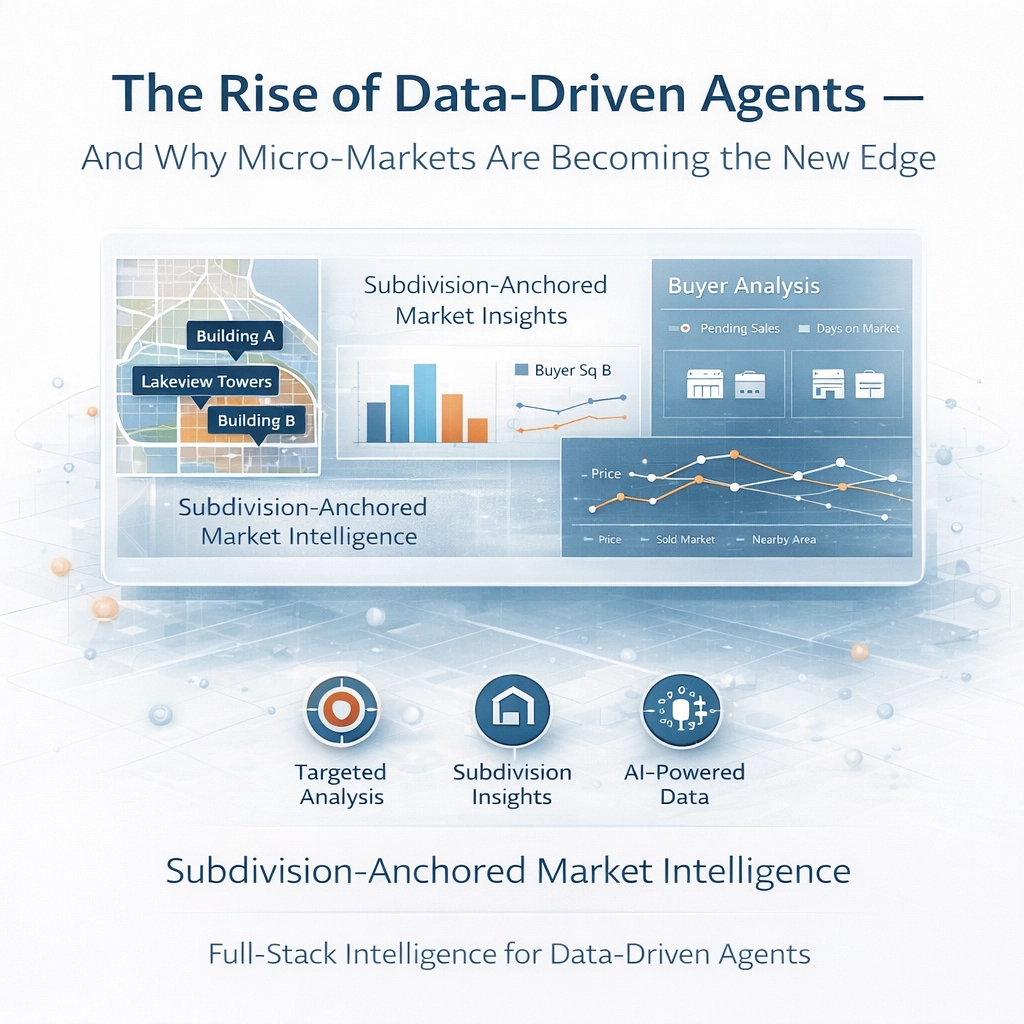
Hyperlocal Advisor, opening in Q1 2026, is being built as an AI-native real estate brokerage designed around structured, subdivision-level intelligence — not generic market summaries.
The brokerage is powered by the proprietary data platform behind Subdivisions.com, which focuses on defining markets the way professionals already think about them: by community, building, and micro-market behavior.
The goal is not to automate agents out of the process.
It’s to equip them with better inputs.
What This Enables for Content-Driven Agents
For agents actively creating video content, access to subdivision-anchored data and analytics enables:
1. More Precise Market Explanations
Agents can discuss pricing and demand inside a defined community instead of relying on blended averages.
2. Stronger Educational Authority
Explaining how comparable units actually compete builds credibility faster than repeating public stats.
3. Higher-Intent Audiences
Content grounded in real market behavior attracts viewers who are closer to making decisions — not just browsing.
4. Consistency Without Guesswork
Structured data reduces the need to speculate or oversimplify complex markets for the sake of content.
The Role of AI — Used Carefully
Industry research is clear on one point: AI adds value when it organizes and interprets data, not when it replaces professional judgment.
At Hyperlocal Advisor, AI is intended to support agents by:
organizing subdivision- and building-level market data
identifying relevant comparables
translating trends into plain-language explanations
This aligns with how AI is being adopted across finance, legal research, and analytics-heavy industries: as an assistive system, not a decision-maker.
An Invitation to a Different Kind of Agent
As Hyperlocal Advisor prepares to open, the focus is on working with agents who already understand that:
attention alone doesn’t sustain trust
insight compounds faster than volume
credibility matters more as audiences mature
This is not a mass recruitment effort.
It’s an invitation to agents who want their content to reflect how markets actually work — and who see value in grounding their public presence in structured, defensible market intelligence.
Closing Thought
Social platforms changed how agents reach people.
They didn’t change how value is formed.
As buyers become more informed, the agents who can explain markets at the micro level — clearly, accurately, and without hype — will continue to earn attention long after trends shift.
That’s the problem Hyperlocal Advisor is being built to solve.
About Hyperlocal Advisor
Hyperlocal Advisor is an AI-native real estate brokerage opening in Q1 2026, powered by subdivision- and building-level market intelligence from Subdivisions.com. The platform is designed to help agents, buyers, and homeowners better understand real estate value through structured micro-market data, analytics, and AI-assisted interpretation.